Losing weight can sometimes feel complicated.
You hear about low-carb diets, intermittent fasting, cutting sugar, eating clean, doing more cardio, hitting 10,000 steps, and dozens of other strategies.
But underneath most successful weight-loss approaches is one basic principle:
You need to consistently consume fewer calories than your body uses.
This is called a calorie deficit.
The idea itself is simple. The harder part is knowing how much you're actually eating --- and staying consistent enough for it to matter.
What Is a Calorie Deficit?
Your body needs energy every day.
You use calories to keep your heart beating, breathe, maintain body temperature, walk around, work, exercise, and basically do everything else that keeps you alive.
If your body uses around 2,500 calories per day and you consume 2,500 calories, you're roughly around maintenance.
If you consistently consume more than your body needs, the excess energy can contribute to weight gain over time.
But if you consume less than your body needs --- for example, eating 2,000 calories while your body uses around 2,500 --- your body has to make up for that energy difference.
That's the basic idea behind a calorie deficit.
It doesn't mean you need to starve yourself or eat as little as possible. A sustainable deficit is about creating a manageable difference between the energy you consume and the energy your body uses.
Weight loss also isn't perfectly linear. Water retention, sodium, digestion, hormones, activity levels, and other factors can make your weight fluctuate from one day to another.
That's why consistency over time matters much more than what happens on a single day.
Why Tracking Your Food Can Help
Knowing that you need a calorie deficit is one thing.
Knowing whether you're actually in one is another.
It's surprisingly easy to underestimate how much we eat.
A spoonful of sauce, cooking oil, snacks between meals, sweetened drinks, larger portions, or that "small bite lang" can add up throughout the day.
This is where food tracking becomes useful.
Tracking gives you visibility.
Instead of thinking:
"I think I didn't eat that much today."
You have a better idea of what you've actually consumed.
It also doesn't mean that every meal needs to be perfect. You can have a heavier lunch and adjust later. You can enjoy your favorite food while still keeping your overall intake aligned with your goals.
Tracking turns weight management from guessing into something you can observe and adjust.
What Does Research Say About Food Tracking?
Food tracking isn't just a fitness trend.
Self-monitoring has long been used as part of behavioral weight-management programs. A systematic review of 22 studies found a consistent positive association between self-monitoring behaviors and successful weight-management outcomes, although the researchers also noted limitations in the quality of the available evidence.
More recent research has looked specifically at digital tracking.
A 2021 systematic review and meta-analysis of 12 randomized controlled trials found that digital self-monitoring of diet and physical activity supported greater weight loss and reductions in calorie intake among adults with overweight or obesity.
Another systematic review covering 59 behavioral weight-loss studies found that both higher- and lower-intensity dietary self-monitoring approaches may support weight loss.
The CDC also recommends tracking nutrition as one way to understand your current habits when working toward healthy weight loss.
The important takeaway isn't that tracking magically causes weight loss.
Tracking creates awareness.
And awareness can make it easier to stay consistent with the habits that support your goal.
References
- Self-monitoring in weight loss: a systematic review of the literature
- Digital self-monitoring of diet and physical activity and weight loss
- Dietary self-monitoring and weight loss
- CDC --- Steps for Losing Weight
But There's One Problem: Tracking Food Can Be Annoying
Here's where things become difficult in real life.
Traditional calorie tracking often means:
- Weigh your food.
- Search for each ingredient.
- Figure out the serving size.
- Calculate calories.
- Calculate protein, carbohydrates, and fat.
- Add everything into an app.
- Repeat for your next meal.
If you prepare everything yourself and have the time to measure every ingredient, that's great.
But most of us have jobs.
We commute.
We go to the gym.
We have families.
We eat at restaurants.
We order food.
And sometimes we look at our plate and have absolutely no idea how many grams of chicken are sitting there.
After doing this several times every day, tracking can start feeling like another chore.
And when tracking becomes inconvenient, consistency becomes harder.
That's the problem we're trying to solve with OopsCalorie.
Meet OopsCalorie
OopsCalorie is being built around a simple idea:
Food tracking should take seconds, not minutes.
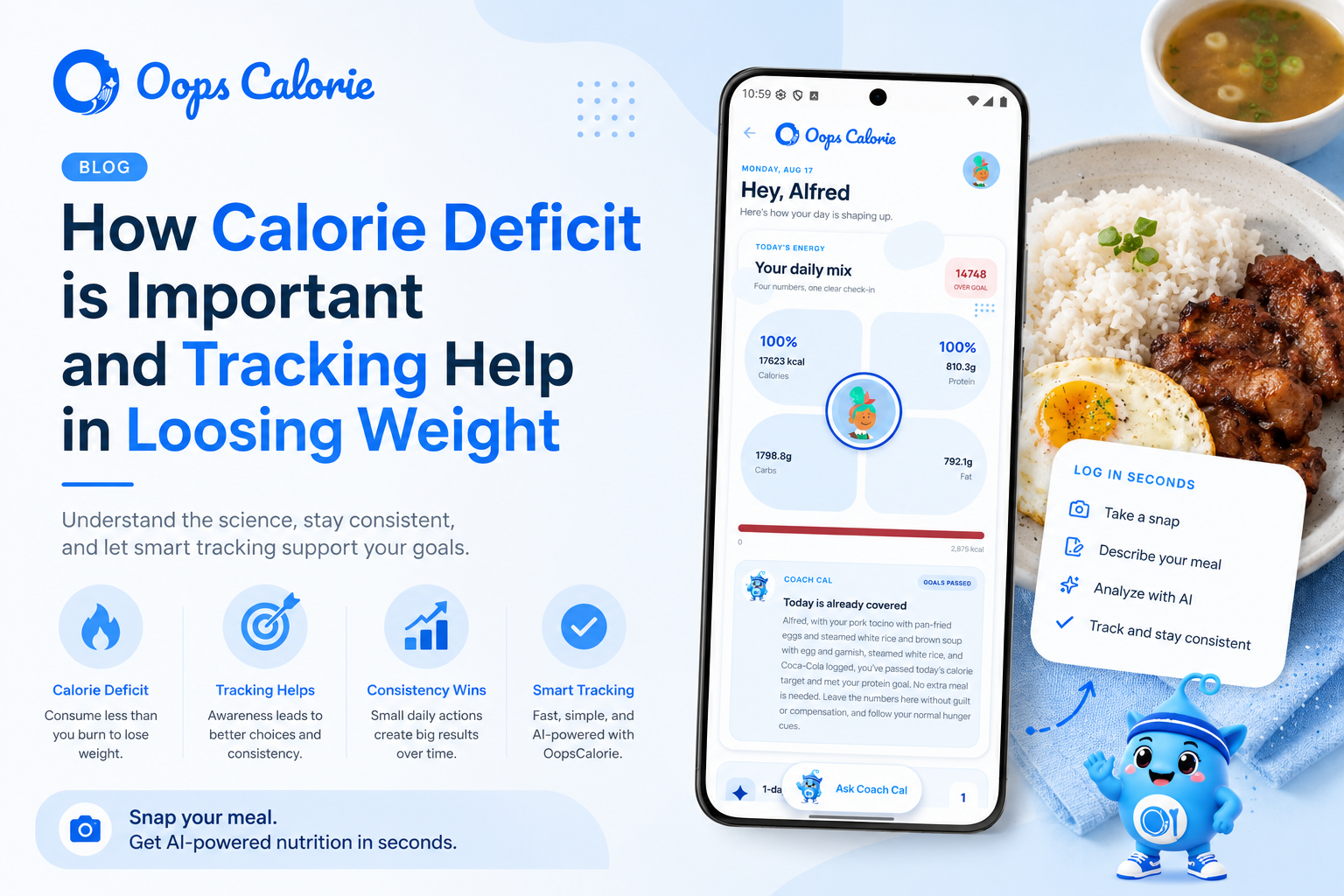
Instead of manually searching databases and entering every ingredient individually, OopsCalorie uses AI to help estimate your meal from a photo and the context you provide.
The goal isn't to replace a food scale or pretend that AI can magically know the exact calories hiding inside your plate.
The goal is much simpler:
Make everyday food tracking fast enough that you'll actually keep doing it.
Because an estimate you consistently track can sometimes be more useful for building awareness than a complicated tracking system you eventually stop using.
How OopsCalorie Works
The process is intentionally simple.
1. Take a Snap 📸
Open OopsCalorie and take a photo of your meal.
No need to spend several minutes searching for every food item before you can start eating.
2. Give It Some Context 💬
Photos can't tell the whole story.
Two dishes can look almost identical while having completely different ingredients, preparation methods, or serving sizes.
So you can give OopsCalorie additional context about what you're eating.
For example:
"1 cup rice, pork adobo, and Coke Zero."
Or:
"Chicken breast cooked with a little olive oil, around one cup of rice."
That extra context helps the AI understand your meal better instead of relying entirely on what it sees in the image.
3. Let OopsCalorie Analyze It ✨
OopsCalorie combines the meal photo and your description to estimate your food intake, including calories and macronutrients such as:
- Calories
- Protein
- Carbohydrates
- Fat
You review the estimate, make adjustments when necessary, and log your meal.
That's it.
Snap. Describe. Analyze. Log.
We're Not Trying to Make Tracking Perfect
There's an important distinction here.
AI-based food analysis is still an estimate.
A photograph can't reliably determine every ingredient, exact serving weight, amount of cooking oil, hidden sauce, or preparation method.
If you're an athlete following an extremely precise nutrition program or you need accurate nutritional information for medical reasons, weighing and measuring your food remains the more appropriate approach.
OopsCalorie is designed for everyday people who want a practical way to become more aware of what they're eating without turning every meal into a mathematics exercise.
We're trying to reduce the friction between:
"I should track what I'm eating."
and
"Done."
Consistency Beats Complexity
You don't need to make your diet complicated to start understanding it.
You don't need to eat perfectly every day.
And you don't necessarily need to calculate every gram of food manually.
What matters is understanding your habits and making adjustments that you can sustain over time.
Calorie tracking can help provide that awareness.
A calorie deficit provides the direction.
Consistency is what keeps you moving.
And that's what we're building OopsCalorie around:
Less time logging. More time living.
Take a snap. Tell us what you're eating. Let OopsCalorie help with the rest.
------------------------------------------------------------------------
Disclaimer: OopsCalorie provides estimated nutritional information for general wellness and tracking purposes. Estimates may vary based on portion size, ingredients, preparation methods, and image quality. It is not a substitute for professional medical or nutritional advice.
Comments 0
No approved comments yet. Start the conversation.